01 Overview
UC1 explores how innovative finance can sustain biodiversity-friendly Alpine forest management across two representative sites — one in Italy, one in Austria. Led by JSC One, it runs along the BIO-CAPITAL timeline and feeds the project’s work on biodiversity baselines, financing mechanisms and stakeholder engagement.
- Location
- Italian & Austrian Alps
- Ecosystem
- Alpine forests & high-altitude habitats
- Lead partner
- JSC One
- Scale
- ~20,000 ha (IT) · ~1,400 ha (AT)
- Policy frame
- EU Biodiversity & Forest Strategies 2030, Nature Restoration Regulation
02 Location & ecosystem profile
The Italian case study covers around 20,000 ha of forest and alpine pasture held by the Magnifica Comunità di Fiemme, a commons institution founded in 1111, including several Natura 2000 sites. The Austrian case study is roughly 1,400 ha of privately owned forest in the Radlgraben (Upper Carinthia), rising from 900 to 2,300 m. Both span alpine and subalpine grasslands, peat bogs, scree, rocky habitats and high-value conifer forests.
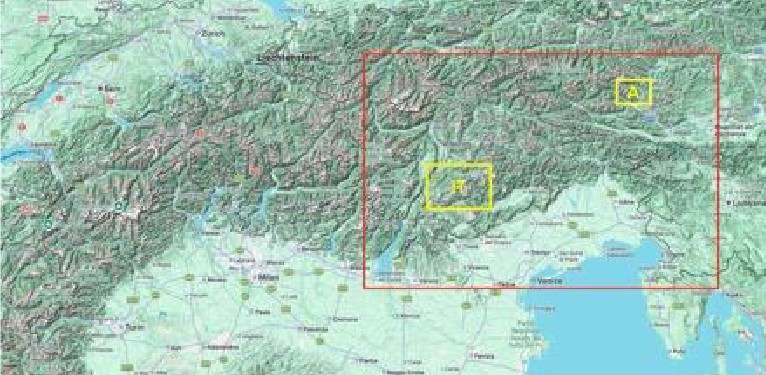
Figure 1: UC1 Alpine reference areas in Italy and Austria.
03 Environmental context
These compressed mountain life zones host exceptional biodiversity — large carnivores, ibex, raptors and a rich invertebrate fauna. The main pressures are the loss of traditional silvo-pastoral practices, mechanised forestry, and increasingly severe wind- and snow-throw that heightens vulnerability to pest outbreaks.
Climate change hits hard at altitude. In 2018, Storm Vaia caused unprecedented windthrow followed by enduring bark-beetle damage at both sites.
04 Use Case Objectives
The goal is to find financially viable pathways that preserve and restore biodiversity while reducing dependence on timber revenue. Environmental aims include enhancing forest biodiversity and habitat quality, increasing climate resilience, promoting mixed-species natural regeneration, protecting soils and watersheds, improving connectivity and supporting carbon sequestration.
The work aligns with the EU Biodiversity Strategy 2030, the EU Forest Strategy 2030 and the Nature Restoration Regulation; the Austrian site is additionally pursuing recognition as an OECM (Other Effective Area-based Conservation Measure).
05 Beneficiaries
Primary beneficiaries are the landowners and managers responsible for conserving habitats and protecting species. Secondary beneficiaries include actors along the forestry value chain, impact investors, and local communities that rely on the forest for recreation and water supply.
06 Methodology
Research begins with a desk review (WP2) of the policy and legal framework for biodiversity protection and of relevant financial instruments, assessing each for suitability, feasibility and scalability. Findings then feed continuous stakeholder engagement at both sites — one-to-one meetings and workshops with landowners, conservation authorities, research institutions, NGOs and forest-sector operators — to co-design viable business models with the WP4 and WP5 teams.
07 Innovative financial mechanisms
A structured Natural Capital Accounting system, a credible MRV framework, clear biodiversity indicators and strong governance are the enabling conditions for moving beyond timber revenue. Against these, UC1 examines the most relevant instruments:
08 Risks
The transition carries several layered risks: exogenous climatic and biological disturbance; legal-institutional complexity in changing established business models; dependence on the active involvement of impact investors and public authorities; operational difficulty in setting up new systems such as Natural Capital Accounting and MRV; and questions of social acceptance that can slow implementation. These are managed through careful planning, close work across work packages, and frequent stakeholder dialogue.
09 Implementation roadmap
01 Overview
UC2 is a practice-oriented use case on regenerative agriculture in the Aube department of north-eastern France. Led by Agri Sud-Ouest Innovation with AgroSolutions and participating landowners, it works with farms that have practised conservation agriculture for years — making it a testbed for turning established ecological performance into financeable biodiversity outcomes.
- Location
- Aube, Grand Est, NE France
- Ecosystem
- Arable land, pastures & vineyards
- Lead partner
- Agri Sud-Ouest Innovation
- Scale
- Plot & farm level (demonstration plots)
- Policy frame
- EU Biodiversity Strategy 2030, Green Deal, CAP, Farm to Fork
02 Location & ecosystem profile
The Aube has a temperate, continental-influenced climate (650–800 mm annual rainfall) supporting wheat, barley, rapeseed and sugar beet. The study plots lie outside Natura 2000 areas. Participating farmers work through two organisations: APAD, an NGO promoting conservation agriculture, and SCARA, a regional cooperative. Plots are studied as individual units but understood within wider farming systems, with cross-regional engagement reaching towards Occitanie.
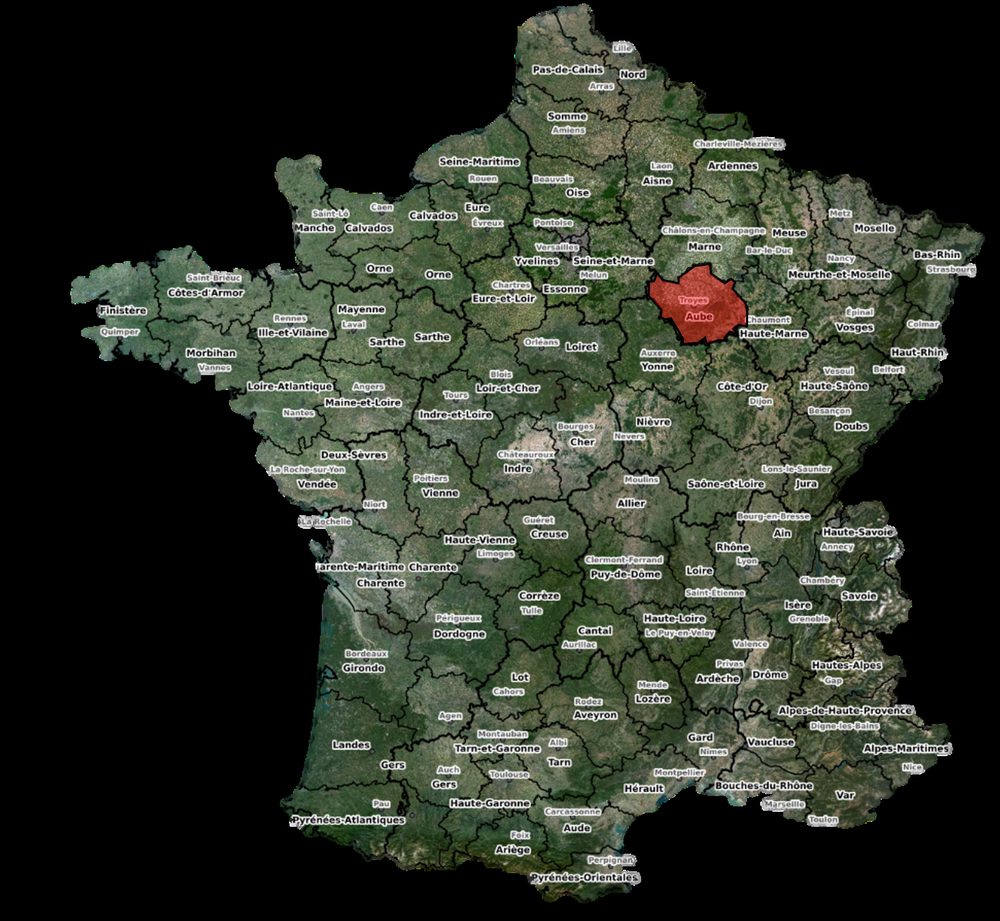
Figure 1: Location of the Aube department within France.
03 Environmental profile
The use case focuses on agricultural biodiversity measurable by geodata: crop and livestock diversity, and semi-natural elements such as hedgerows, flower strips and wetlands that raise habitat complexity. Historical pressures include the shift to monocultures, pesticide and fertiliser use, land-use change and the loss of hedgerows and field margins.
Climate change adds shifts in species distribution, soil degradation and water stress. The biodiversity baseline is captured through each plot’s technical itinerary and landscape features, with indicators being developed in WP3.
04 Use Case Objectives
The aim is to restore biodiversity within productive farming so as to strengthen pollination, soil fertility, natural pest control, water regulation and carbon storage. France is already a frontrunner in agroecology — through the 2014 Loi d’Avenir, GIEE collectives and CAP eco-schemes — which positions UC2 to test how mature regenerative systems can be rewarded financially.
It aligns with the EU Biodiversity Strategy 2030, the European Green Deal, the CAP, the Water Framework Directive, the Farm to Fork Strategy and the UN SDGs. Its distinctive role is to pilot the scaling and standardisation of biodiversity-based instruments in high-performance regenerative systems.
05 Beneficiaries
Primary beneficiaries are landowners and farmers, who would receive support to implement biodiversity-friendly practices. Secondary beneficiaries include private investors, public institutions and governments, consumers, NGOs and advocacy groups, and agri-food supply-chain stakeholders.
06 Methodology
The methodology centres on monitoring agroecological practices across a varied pool of farms (WP3): engaging farmer groups to adopt agro-ecological infrastructure and transition practices; experimenting with biodiversity-enhancing measures such as crop diversification, hedgerows and no-till; and evaluating candidate financial mechanisms against deployment potential, governance and certification, cost versus funders’ willingness to pay, and replicability. Monitoring combines ground-level data with geospatial technologies.
07 Innovative financial mechanisms
Instruments are studied in WP2, with the most appropriate selected for the French context. Remote sensing underpins verification, while clear regulatory frameworks and ESG-driven corporate demand act as enablers. Key barriers are the difficulty of valuing biodiversity, immature credit markets, and the limits of remote sensing for species-specific data.
08 Risks
Transition risks are agronomic, climatic, economic and methodological. Short-term yield variability is mitigated through diversified rotations, technical support from SCARA and peer exchange within APAD. Climatic risks (drought, late frost) are buffered by improved soil structure and parametric insurance. Income uncertainty is addressed through PES, certificates and green loans; measurement gaps by combining remote sensing with in-situ observation; and regulatory uncertainty through engagement with authorities in both Grand Est and Occitanie.
09 Implementation roadmap
01 Overview
UC3 is built around two complementary interventions in Romania’s South Muntenia region: a farm using forest belts within intensive arable land, and a certified organic farm. Led by the Institute of Agricultural Economics and Rural Development (ICEADR) in Bucharest, it asks how financial mechanisms can incentivise agroecological practices and green infrastructure in intensively cultivated lowlands.
- Location
- South Muntenia, Romania
- Ecosystem
- Lowland arable land & green infrastructure
- Lead partner
- ICEADR, Bucharest
- Scale
- Two pilot farms (IalomiȚa & Călărași)
- Policy frame
- EU Biodiversity Strategy 2030, Green Deal, CAP eco-schemes
02 Location & ecosystem profile
At Bucu (Ialomița), forest curtains transform an intensive plain of wheat, corn and sunflower into green infrastructure, creating local ecological corridors near a forest and a lake. At Vâlcele (Călărași), a certified organic farm functions as a biodiversity nucleus in a simplified landscape. Both sit on fertile chernozems that are nonetheless exposed to wind erosion and severe pedological drought under a strong continental climate.
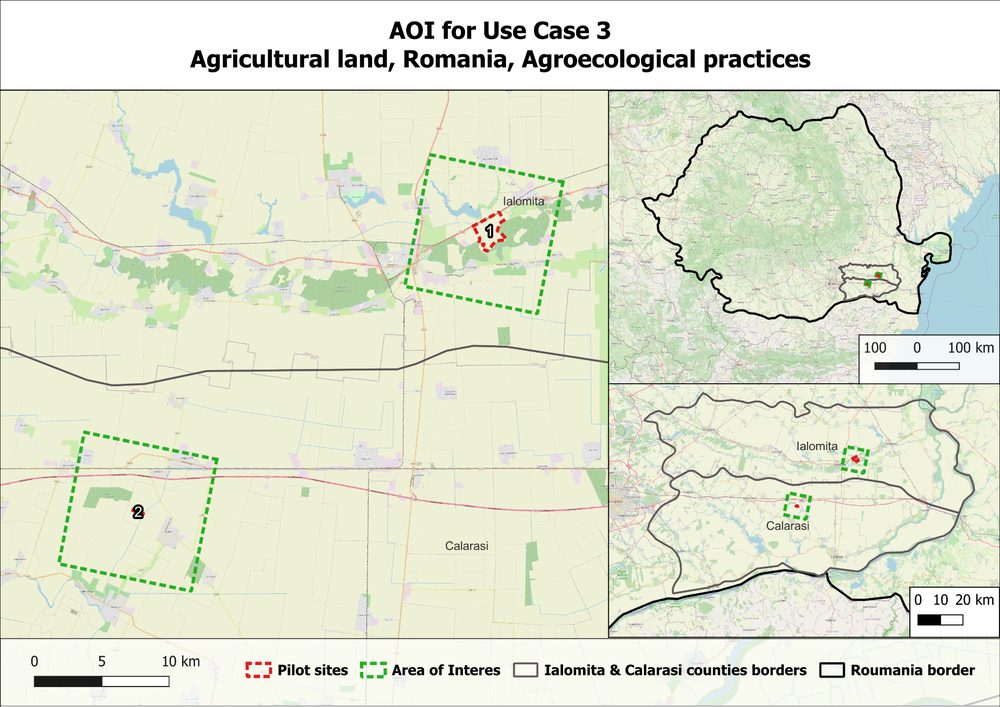
Figure 1: Area of interest for UC3 — pilot sites in Ialomița and Călărași, South Muntenia.
03 Environmental profile
Forest curtains attract pollinators and insectivorous birds and shelter small mammals; the organic farm shows high soil biodiversity, beneficial insects and spontaneous plant species. Threats include ecological isolation from surrounding intensive agriculture, pesticide drift, wind erosion, seedling mortality, and the perception that tree belts take land from cultivation.
The region is among Romania’s most climate-vulnerable — severe water deficit, summers above 40°C, strong winds and erosive torrential rain. Before intervention, the arable site had very low biodiversity; the organic farm was at a moderate but rising level.
04 Use Case Objectives
The objective is to identify and design financial mechanisms that support the uptake and scaling of agroecological practices and green infrastructure in lowland Romania, using the two pilot farms as representative cases. A core idea is to explore a biodiversity-linked instrument — such as a biodiversity-linked bond or performance-based payment — that ties returns to ecological targets like soil health, pollinator activity and habitat connectivity.
Environmental goals target soil and pollinator biodiversity, reduced erosion and greater drought resilience; social goals address farmer perceptions and replicable models for south-east Romania; economic goals demonstrate feasibility and identify new financial flows. It aligns with the EU Biodiversity Strategy 2030, the Green Deal, the CAP, Romania’s National Strategy for Sustainable Development and the Natura 2000 directives.
05 Beneficiaries
Primary beneficiaries are farmers. Secondary beneficiaries include local communities (through microclimatic benefits, dust reduction and soil stabilisation), green-project investors, local and county administrations, and the agri-food sector through more stable production.
06 Methodology
The approach combines bibliographic analysis of agroecology, CAP eco-schemes and the role of forest belts with field-based discussions at the two pilot farms to understand local conditions. It is supported by iterative consultations with other farmers and continuous dialogue with project partners, who contribute technical expertise in defining and testing proposals.
07 Innovative financial mechanisms
Implementation is supported by existing CAP eco-schemes, growing interest in nature-based solutions, and the ecological potential of lowland landscapes. Structural barriers remain: a lack of incentivised funds for maintaining green infrastructure in its early years, the perception that agroecology reduces output, and the absence of functional biodiversity-credit markets nationally. UC3 analyses how these constraints can be overcome through appropriate instruments and continuous dialogue.
08 Risks
The use case faces operational risks from high climate variability and severe drought, which can dampen both motivation and early-year results. Institutional risks arise from administrative complexity and the limited integration of innovative instruments into existing policy. Social and economic risks include the perception of agroecology as costly, immature biodiversity-credit markets, and limited local administrative capacity. Mitigation rests on continuous dialogue with farmers and authorities, realistic feasibility assessment, and gradual testing with partners.
09 Implementation roadmap
01 Overview
UC4 addresses nature-based solutions for pollinators in species-rich semi-natural grasslands across nine Natura 2000 sites in Slovenia, with Goričko and Osrednje Slovenske gorice as focal landscapes. Led by Pratensis, it combines a national policy and financing perspective with site-level implementation — analysing biodiversity that exists only because of continued low-intensity management.
- Location
- Slovenia (9 Natura 2000 sites)
- Ecosystem
- Semi-natural, management-dependent grasslands
- Lead partner
- Pratensis
- Scale
- National to parcel; focal Goričko & Osrednje Slovenske gorice
- Policy frame
- EU Biodiversity Strategy 2030, Birds & Habitats Directives, CAP, NRR
02 Location & ecosystem profile
Goričko is both a Nature Park and Natura 2000 site of about 46,200 ha at the Alpine–Pannonian transition, part of the trilateral Three Countries Park. Osrednje Slovenske gorice covers roughly 2,076 ha and is especially important for meadows and butterflies. The wider use case spans semi-natural grasslands and mosaic farmland with hedgerows, orchards and woody patches — managed by small, heterogeneous farms under fragmented ownership. Relevant habitat types are 6210, 6410, 6510 and 6520.
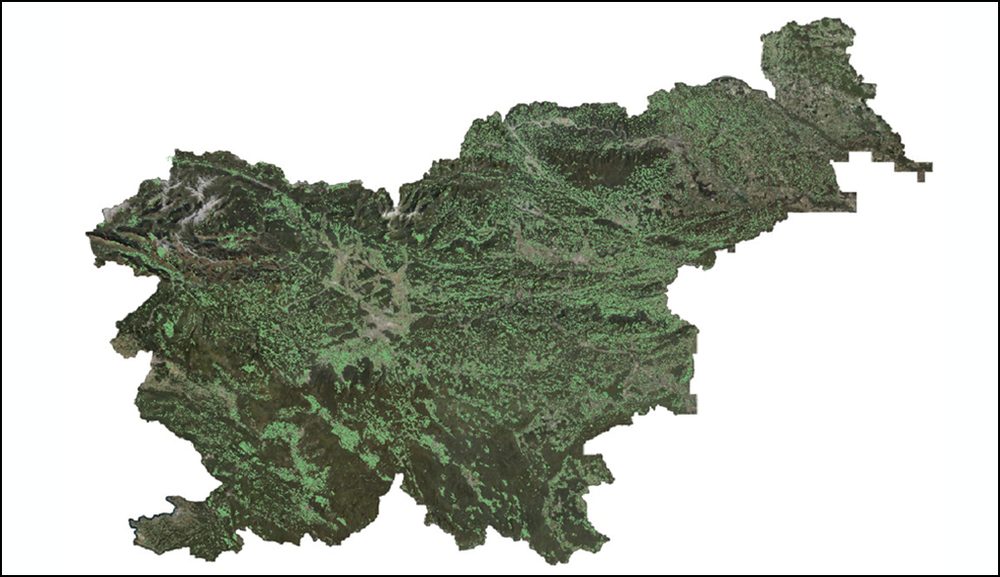
Figure 1: Spatial distribution of grasslands in Slovenia.
03 Environmental profile
These grasslands support high plant, pollinator and butterfly diversity, with indicator species such as Phengaris teleius, Phengaris nausithous and Lycaena dispar. Pressures include intensification, abandonment, woody encroachment, fragmentation and the loss of traditional management — reinforced by ageing farmers, depopulation and low profitability.
Climate change brings hotter, drier summers, drought, frost, storms and hail. Many target habitats remain in unfavourable conservation status, and key butterfly indicators are declining.
04 Use Case Objectives
UC4 seeks financing approaches that help conserve and restore species-rich grasslands, linking biodiversity-positive management to measurable indicators, stakeholder-supported governance and finance that complements existing public support. Environmental goals focus on habitat quality for pollinators; social goals on the viability of traditional management amid depopulation; and economic goals on combining public and innovative finance without replacing the CAP baseline.
It aligns with the EU Biodiversity Strategy 2030, the European Green Deal, the Birds and Habitats Directives, the Natura 2000 framework, the CAP, the Nature Restoration Regulation and the EU Pollinators Initiative, with KPIs covering habitat condition, indicator species and scheme participation.
05 Beneficiaries
Primary beneficiaries are farmers, tenants and land managers responsible for grassland management, together with the habitats and species that depend on appropriate mowing, grazing and restoration. Secondary beneficiaries include local communities, municipalities, protected-area managers, Natura 2000 and conservation institutions, public authorities, advisory bodies, NGOs, processors, tourism actors and potential future private funders.
06 Methodology
The methodology combines policy and financing analysis (WP2), biodiversity baselines and indicators (WP3), development of financial solutions such as PES and biodiversity certificates (WP4 and WP5), and stakeholder engagement (WP6). Remote sensing and GIS support land-cover and habitat analysis; field visits and expert input validate spatial data; and ecological, financial and social indicators are tracked to underpin future MRV-compatible financing.
07 Innovative financial mechanisms
The financial architecture is a mixed model: public funding (mainly CAP) remains the baseline, while BIO-CAPITAL explores how innovative mechanisms could complement it. The framework is well suited to Triple Capital Accounting, since grassland value depends simultaneously on natural, human/social and financial capital. Enabling conditions include clear indicators, credible MRV and additionality rules; barriers include fragmented ownership, short leases, low trust, transaction costs and the risk of double-funding with the CAP.
08 Risks
Environmental risks include drought, heat, frost, storms, hail, flooding and continued habitat deterioration. Operational risks stem from fragmented ownership, informal leases, low trust, administrative complexity and the gradual loss of local management capacity. Financial risks include low profitability of extensive management, immature biodiversity-finance markets and weak private demand. Mitigation rests on continued CAP support, farmer advisory and engagement, pilot testing, risk-mitigation tools, clearer indicators and MRV, and stronger institutional coordination.
09 Implementation roadmap
01 Overview
UC5 focuses on restoring and protecting river corridors and wetland buffers in south-west England, with demonstration sites across Devon and Cornwall. Led by the Westcountry Rivers Trust with engaged landowners, it tests whether Biodiversity Net Gain, conservation covenants and emerging biodiversity certificates can become real routes to finance river restoration.
- Location
- Devon & Cornwall, SW England
- Ecosystem
- River corridors & associated wetlands
- Lead partner
- Westcountry Rivers Trust
- Scale
- Multiple sites & catchment landscapes
- Policy frame
- UK Biodiversity Strategy, 25 Year Environment Plan, WFD, ELM, BNG
02 Location & ecosystem profile
The sites are typical lowland agricultural catchments and valley systems, characterised by traditional hedge-bank systems, where historical modification and land drainage have reduced habitat diversity and connectivity. The use case centres on the restoration of river corridors and associated wetland habitats to enhance biodiversity, improve water quality and strengthen climate resilience.
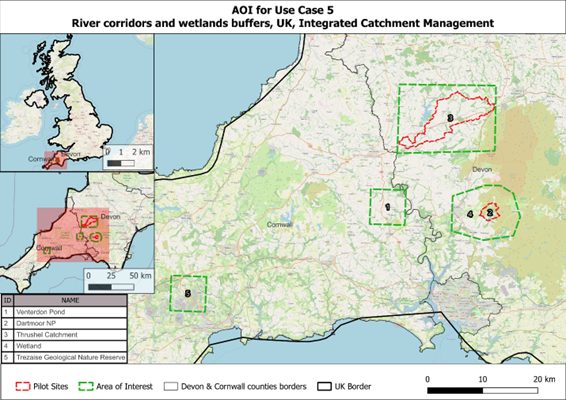
Figure 1: Area of interest for UC5 — river-corridor and wetland sites in Devon and Cornwall.
03 Environmental context
UK wetlands and river corridors form vital, dynamic networks — riffles, pools, fens, reedbeds and wet woodlands that support salmon, trout, otter, water vole, white-clawed crayfish and kingfisher, while delivering nutrient cycling, water purification and flood storage. Historical drainage, channel straightening and embankment building disconnected rivers from floodplains, and today agricultural runoff, urban drainage, weirs and invasive species add further pressure.
Climate change brings more frequent floods and droughts, warmer water and rising sea levels. Most surveyed reaches show low baseline biodiversity value (generally below one unit), indicating strong potential for measurable uplift.
04 Use Case Objectives
The objective is to identify and implement innovative solutions for restoring and protecting riparian and wetland ecosystems — applying conservation covenants, nature-based solutions and Biodiversity Net Gain to deliver measurable gains, and testing whether these can leverage real finance. Economically, it aims to mobilise investment and market-based instruments so that landowners can adopt restoration without compromising viability.
The work aligns with the EU and UK Biodiversity Strategies for 2030, the 25 Year Environment Plan, the Water Framework Directive (retained in UK law) and Environmental Land Management schemes, and contributes to climate adaptation and Net Zero. BNG is now a legal route in the UK for leveraging biodiversity improvements linked to development.
05 Beneficiaries
The primary beneficiary is Nature itself, alongside landowners, farmers and river-corridor managers who may receive financial incentives and gain stewardship and resilience benefits. Secondary beneficiaries include local communities, recreational users, public bodies such as flood authorities, and investors and conservation organisations that benefit from measurable, evidence-based biodiversity gains.
06 Methodology
Remote sensing and GIS enable scalable habitat assessment and spatial mapping of riparian zones and connectivity, informing where interventions deliver the greatest gain. Field methods are detailed: River Condition Assessments using Cartographer software, standardised MoRPh hydromorphological surveys, Biodiversity Net Gain frameworks to quantify habitat units, ground-level soil and water measurements, eDNA sampling for species detection, and sensor-based monitoring of flow, temperature and water quality.
07 Innovative financial mechanisms
Restoration is linked to finance principally through Biodiversity Net Gain, now a legal route in the UK, with habitat units quantifying measurable uplift. Conservation covenants — legal agreements between landowners and a Responsible Body such as WRT, with habitat banks acting as brokers — protect interventions over the long term, while novel biodiversity certificates are tested as a complementary route. The market is still thin: watercourse BNG units are currently valued between £95,000 and £205,000, with scarce availability and complex watercourse ownership.
08 Risks
Environmental risks include floods, droughts and extreme weather, climate impacts on hydrology and species, and invasive or unexpected ecological responses. Operational risks involve stakeholder resistance, land-tenure complexity, multi-site coordination, landowner uncertainty over BNG returns and fluctuating demand for off-site units, and the long-term enforcement obligations of a Responsible Body. Financial risks include short-term funding against 30-year BNG commitments, incentives that may not cover delivery and maintenance, an emerging and uncertain BNG market, high upfront costs and credit-stacking complexity. Mitigation emphasises transparent engagement, capacity building, stacked interventions, adaptive monitoring and diversified funding.