Living Witnesses: How Digital Technology Keeps Ancient Oaks and Collective Memory Alive | MCYR 2026 Blog Competition Winner
The 7th International Multidisciplinary Conference for Young Researchers (MCYR 2026) brought together young scientists from around the world to share their research, exchange ideas, and explore innovative solutions to global challenges.
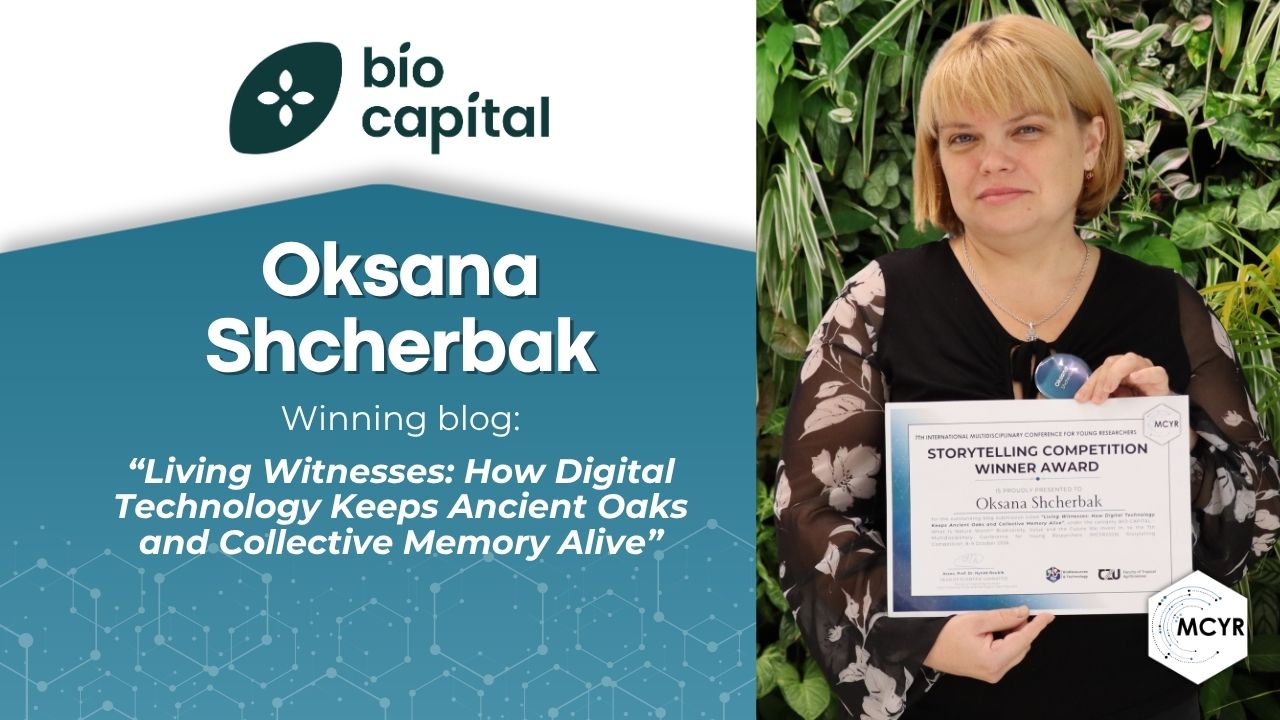
As part of the conference, the MCYR 2026 Blog Competition encouraged participants to communicate their research in creative and accessible ways. “Living Witnesses: How Digital Technology Keeps Ancient Oaks and Collective Memory Alive” by Oksana Shcherbak was selected as the winning entry for the competition topic “BIO-CAPITAL — What Is Nature Worth? Biodiversity, Value and the Future We Invest In”.
Enjoy reading!
Imagine standing under a canopy that has protected generations of people, survived changing climates, and weathered centuries of environmental shifts. In the heart of Ukraine, within the “Chubynsky Farmstead” landscape reserve, grow veteran oaks that have been silent witnesses to history for hundreds of years. These trees are not just massive biological structures; they are living monuments where nature and human memory intertwine. But how can we protect these ancient sanctuaries and share their stories with a global audience interested in ecological preservation?
The answer lies at the intersection of deep roots and modern digital networks. Our research views “Digital Biocultural Heritage” as a powerful tool for socio-environmental communication and community resilience. By transforming a physical ecosystem into an accessible digital experience, we are discovering new paths for increasing environmental awareness and preserving collective memory. This approach directly aligns with the goals of the European Green Deal and the EU Biodiversity Strategy to 2030, offering inclusive models of environmental education for society.
Traditionally, in scientific communication, environmental protection and cultural heritage have been viewed as separate spheres. However, ancient ecosystems like the Chubynsky veteran oaks represent “biocultural heritage” – places where ecological diversity and human history are inseparable. These trees are vital ecological hubs for local biodiversity, providing shelter for many flora and fauna species. At the same time, they are deeply rooted in the local identity and the historical narrative of the Middle Dnipro region.
To capture this multi-faceted essence, our team developed an interdisciplinary framework combining place-based learning, citizen science, and digital science communication. Collaborating with local communities and volunteers, we gathered ecological data, historical narratives, and multimedia content. The result of our joint work was the creation of an interactive digital nature conservation exhibition, “Ancient Oaks of Chubynske: Living Biocultural Heritage of the Middle Dnipro Forest-Steppe.” It successfully integrates visual landscape documentation with scientific interpretation of the ecological and historical-cultural dimensions of the protected area.
The main significance of such a digital presentation lies in its unique ability to overcome physical and geographical borders. Thanks to virtual formats, a local landscape reserve in Ukraine transforms into a global educational and communicative resource. Everyone with internet access can now explore the veteran oak ecosystems, understand their ecological value, and feel a living connection to the history they embody.
Such a digital approach allows for scaling environmental communication, making open science a tangible daily reality. It allows scientific institutions to act as knowledge mediators, go beyond traditional academic publications, and interact directly with the public. By inviting people to engage with the digital exhibition, we bridge the gap between complex ecological data and emotional, narrative-driven human experience.
Today, communities around the world face rapid environmental degradation and the erosion of cultural identity. Developing “place-based environmental awareness” helps people feel their connection to the land, fostering a sense of responsibility and stewardship. This creates a reliable foundation for local resilience in the face of rapid global change. When people learn that an ancient oak is a symbol of historical legacy, nature becomes part of their personal identity. This shared connection strengthens community cohesion, inspiring people to take concrete local actions to preserve biodiversity and adapt to ecological transitions.
We proudly note that this research was conducted by our team based at the M.V. Zubets Institute of Animal Breeding and Genetics of NAAS of Ukraine. Presenting our results within the international “Fascination of Plants Day” campaign was significant recognition for us that digital tools can be effective drivers of change in environmental conservation. Our work is not just a scientific contribution, but our professional commitment to preserve biocultural heritage for future generations, inspiring the world to take global actions for sustainable development.